Planet
Xilvara
The methane super-Earth: a world where you plug in before you eat — into starlight, into electric fields, into the living crystals of the ground.

Xilvara is a super-Earth: a heavy world where gravity weighs 1.32 g and walking feels like carrying someone on your back. The atmosphere is rich in methane and rare gases, the average temperature holds at 14 °C, and the sky is crossed by electrical storms so violent that Arazian probes first took them for weapons fire.
No people ever built here. Xilvara is of no interest to empires: it is of interest to naturalists.
A life that plugs in instead of eating
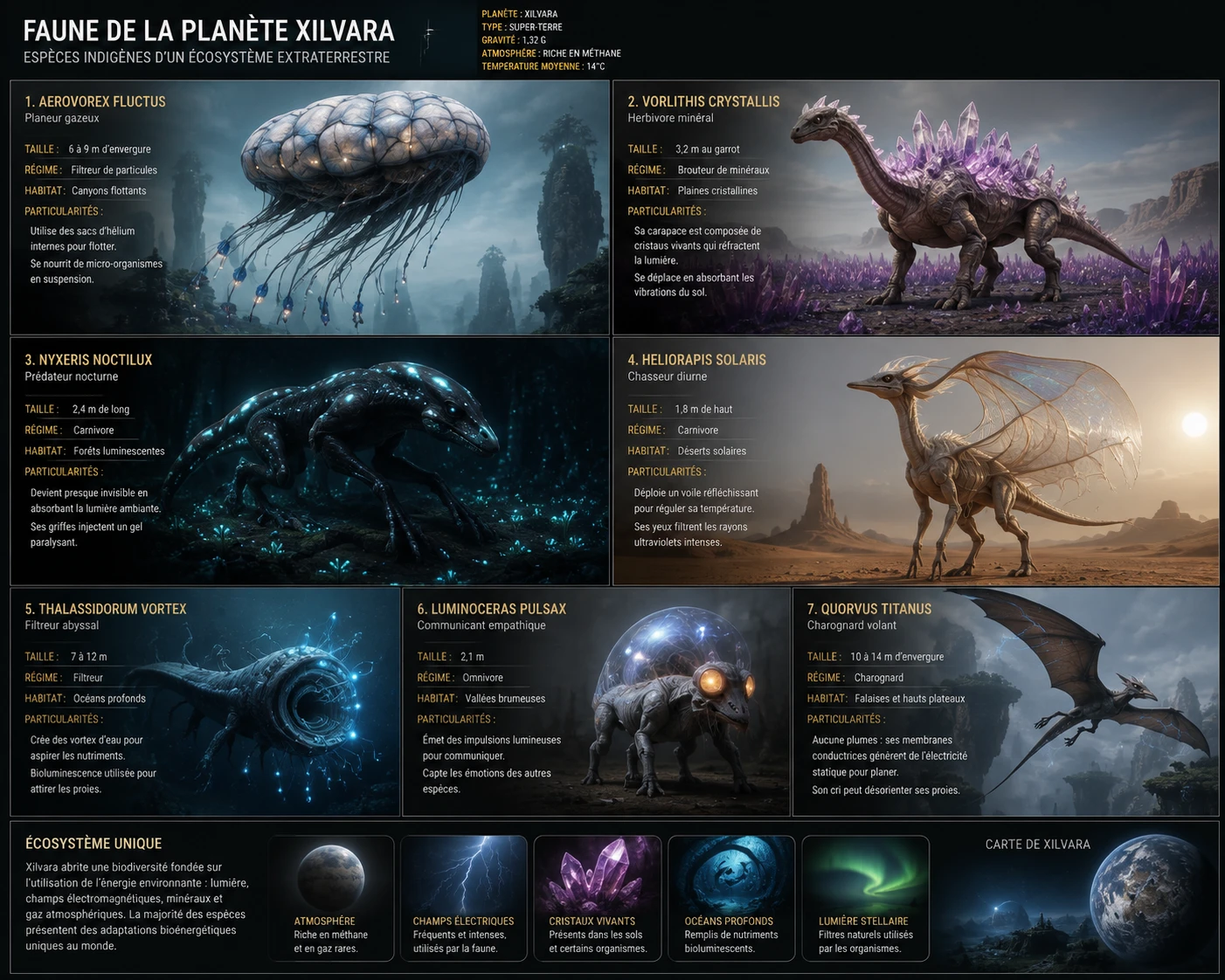 On most worlds life begins with a mouth. On Xilvara it begins with a socket. Every recorded species draws its energy first from its surroundings — from the light of the star, from the electromagnetic fields running through the planet, from the minerals of the soil, from the gases of the air. That is the floor: nobody on Xilvara depends entirely on what it catches.
Which is not to say nothing hunts. Several species eat — but for what the socket does not give: the rare salts, the metals, the compounds no field supplies. On Xilvara you plug in to live, and you hunt to top up.
The archivists retained seven main species:
- Aerovorex fluctus, the gas glider — 6 to 9 metres across, it floats on internal helium sacs and filters the micro-organisms suspended in the floating canyons.
- Vorlithis crystallis, the mineral herbivore — 3.20 m at the shoulder, it grazes the minerals of the crystalline plains. Its carapace is made of living crystals that refract light, and it moves by absorbing the vibrations of the ground.
- Nyxeris noctilux, the night predator — 2.40 m long, it becomes nearly invisible by absorbing the ambient light of the luminescent forests. Its claws inject a paralysing gel.
- Heliorapis solaris, the day hunter — 1.80 m tall, it unfolds a reflective veil to regulate its temperature in the solar deserts, and its eyes filter out ultraviolet.
- Thalassidorum vortex, the abyssal filterer — 7 to 12 m, it spins water vortices to draw in nutrients from the deep oceans and lures its prey with bioluminescence.
- Luminoceras pulsax, the empathic communicator — 2.10 m, an omnivore of the misty valleys. It speaks in pulses of light and reads the emotions of other species.
- Quorvus titanus, the flying scavenger — 10 to 14 m across, without a single feather: its conductive membranes generate the static electricity that keeps it gliding. Its cry disorients its prey.
The crystalline plains
 Some of Xilvara’s ground is not ground at all: it is crystal that grows. It surfaces in violet fields, rises slowly, breaks and grows back, and the fauna grazes it the way elsewhere they graze grass. The Vorlithis goes further and wears it as armour — the line between the beast and the landscape is not very sharp on this planet.
The storms and the floating canyons
 The electric fields of Xilvara are frequent and intense, and the whole of local biology makes use of them: to glide, to hunt, to speak. Above the canyons, where the air is most charged, the great gas gliders drift so slowly that they pass for clouds — until one of them crosses the star and you see its filaments hanging thirty metres down.
Below, the deep oceans are full of bioluminescent nutrients: at night, the water of Xilvara gives more light than its sky.