Planet
Zytharis
The oceanic super-Earth: cliffs that float, forests that glow, ionised deserts, and a twenty-metre creature that builds its shelters by bending gravity.
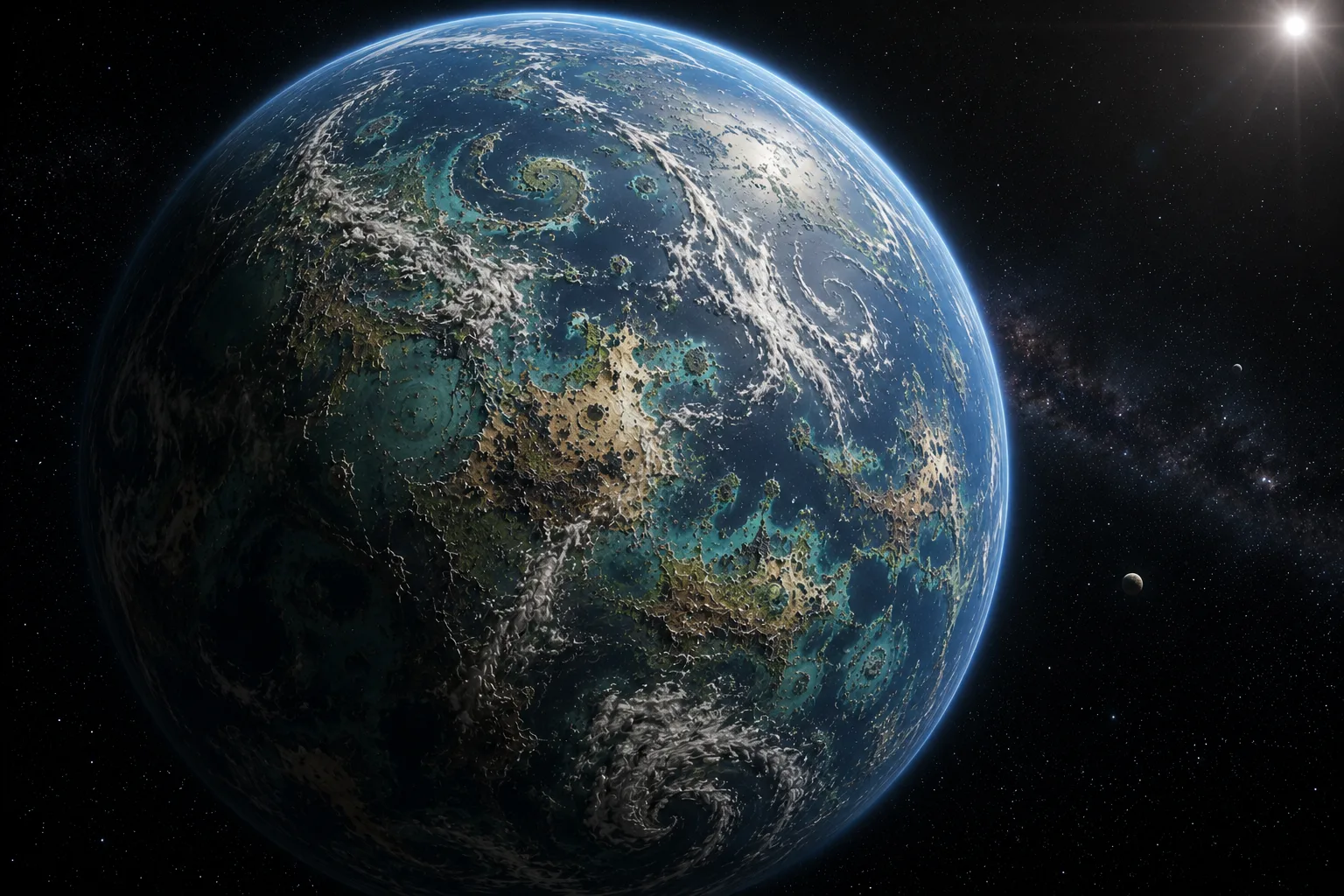
Zytharis is an oceanic super-Earth: a broad world at 1.16 g, whose water covers most of the surface. Its atmosphere mixes nitrogen, argon and ammonia vapour — unbreathable for an Arazian as for a human — and its average temperature holds at 22 °C.
It is a world rich in energetic phenomena. Everything here rests on the meeting of three things: bioluminescence, magnetic fields and thermal currents. The fauna did not merely learn to survive them: it learned to use them.
Nine ways of using a planet
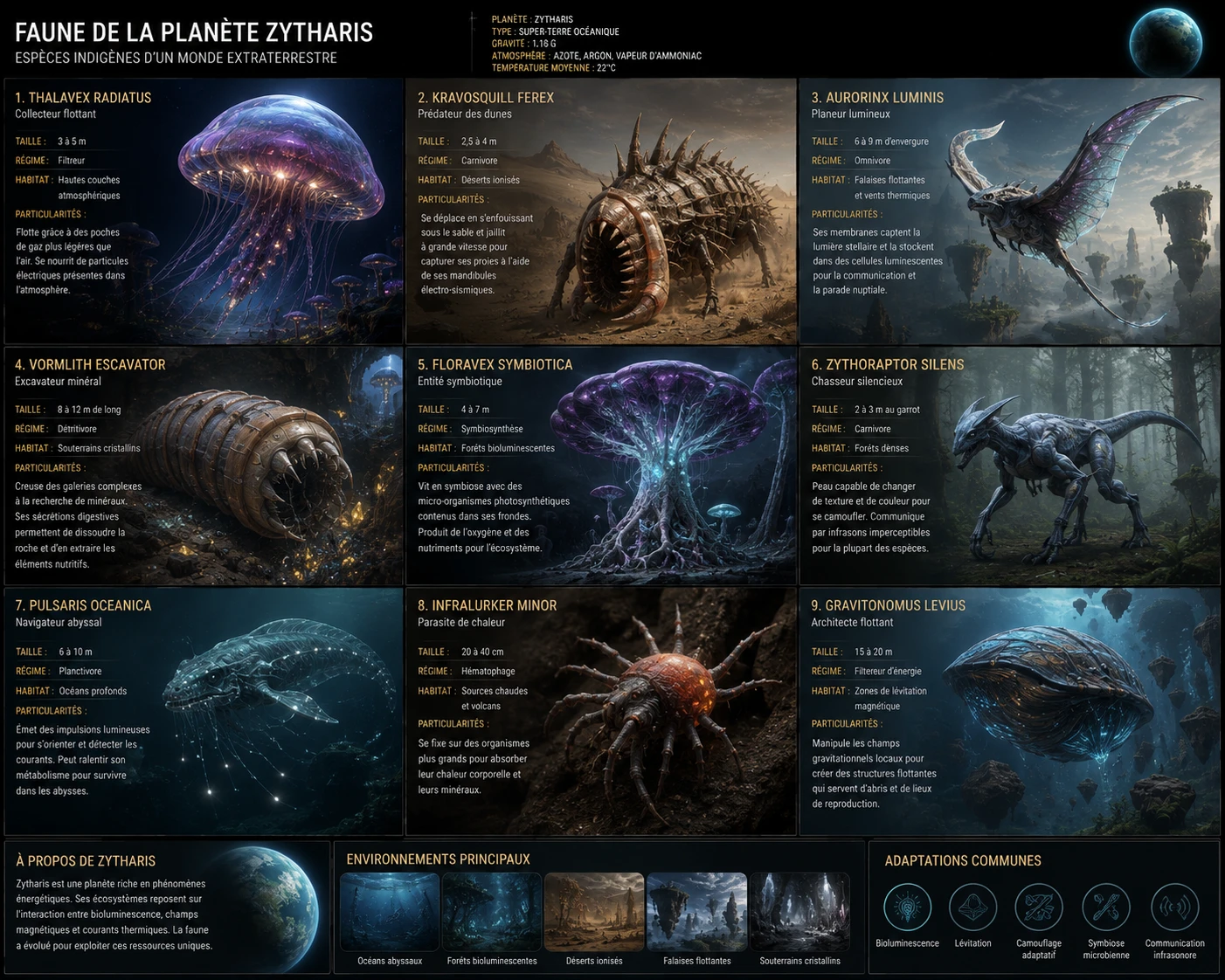 Surveys record nine main species, spread across the planet’s five great environments — abyssal oceans, bioluminescent forests, ionised deserts, floating cliffs and crystalline undergrounds:
- Thalavex radiatus, the floating collector — 3 to 5 m. It floats in the upper atmosphere on pockets of gas and feeds on the electric particles in the air.
- Kravosquill ferex, the dune predator — 2.5 to 4 m. It travels buried under the sand of the ionised deserts and bursts out at speed, electro-seismic mandibles first.
- Aurorinx luminis, the luminous glider — 6 to 9 m across. Its membranes capture starlight and store it in luminescent cells, which it uses to speak and to court.
- Vormlith escavator, the mineral excavator — 8 to 12 m long. A detritivore of the crystalline undergrounds, it digs entire galleries; its digestive secretions dissolve rock to extract nutrients from it.
- Floravex symbiotica, the symbiotic entity — 4 to 7 m. Neither quite plant nor quite beast: it lives in symbiosis with the photosynthetic micro-organisms held in its fronds, and produces the sugars and nutrients the rest of the forest lives on. What it vents is not oxygen but hydrogen, taken up at once by the ammonia in the air — the loop is closed, and the atmosphere of Zytharis has never changed.
- Zythoraptor silens, the silent hunter — 2 to 3 m at the shoulder. Its skin changes texture and colour, and it communicates in infrasound most species cannot hear.
- Pulsaris oceanica, the abyssal navigator — 6 to 10 m. It emits pulses of light to orient itself and read the currents, and can slow its metabolism to endure the deeps.
- Infralurker minor, the heat parasite — only 20 to 40 cm. It fastens onto larger organisms near hot springs and volcanoes to take their body heat and their minerals.
- Gravitonomus levius, the floating architect — 15 to 20 m. In the zones of magnetic levitation it manipulates the local gravitational fields to assemble floating structures that serve it as shelter and as breeding ground.
The cliffs that do not fall
 Above the ocean of Zytharis, whole slabs of rock hold in the air with nothing to support them. The Arazians call them the levitation zones, for want of a better word: no probe has ever measured what carries them. The local magnetic field is violent, the rock there is saturated with metals, and the instruments return readings the archivists of Oravaya gave up publishing. Thermal winds rise there in columns, and the great gliders let themselves be carried for days.
Some of those structures are not natural. The Gravitonomus builds them — which makes it, with neither mind nor city, the only known architect in the system.
The forests that give light
 Under the canopy of Zytharis there is no night. The bioluminescent forests are lit by the organisms living in them — the fronds of the Floravex, the traces left on the ground, the pulses of one creature answering another — and light serves there as a language as much as an illumination.
That is also what makes the Zythoraptor formidable: in a world that speaks in light and colour, a hunter that changes its skin and murmurs below the threshold of hearing goes literally unnoticed.