Planet
Nerya
The ocean world with two moons: 88% turquoise water, purple forests, thirty-metre tides and cities lying flat along the coasts — a habitable world whose very name irritates the Arazians.
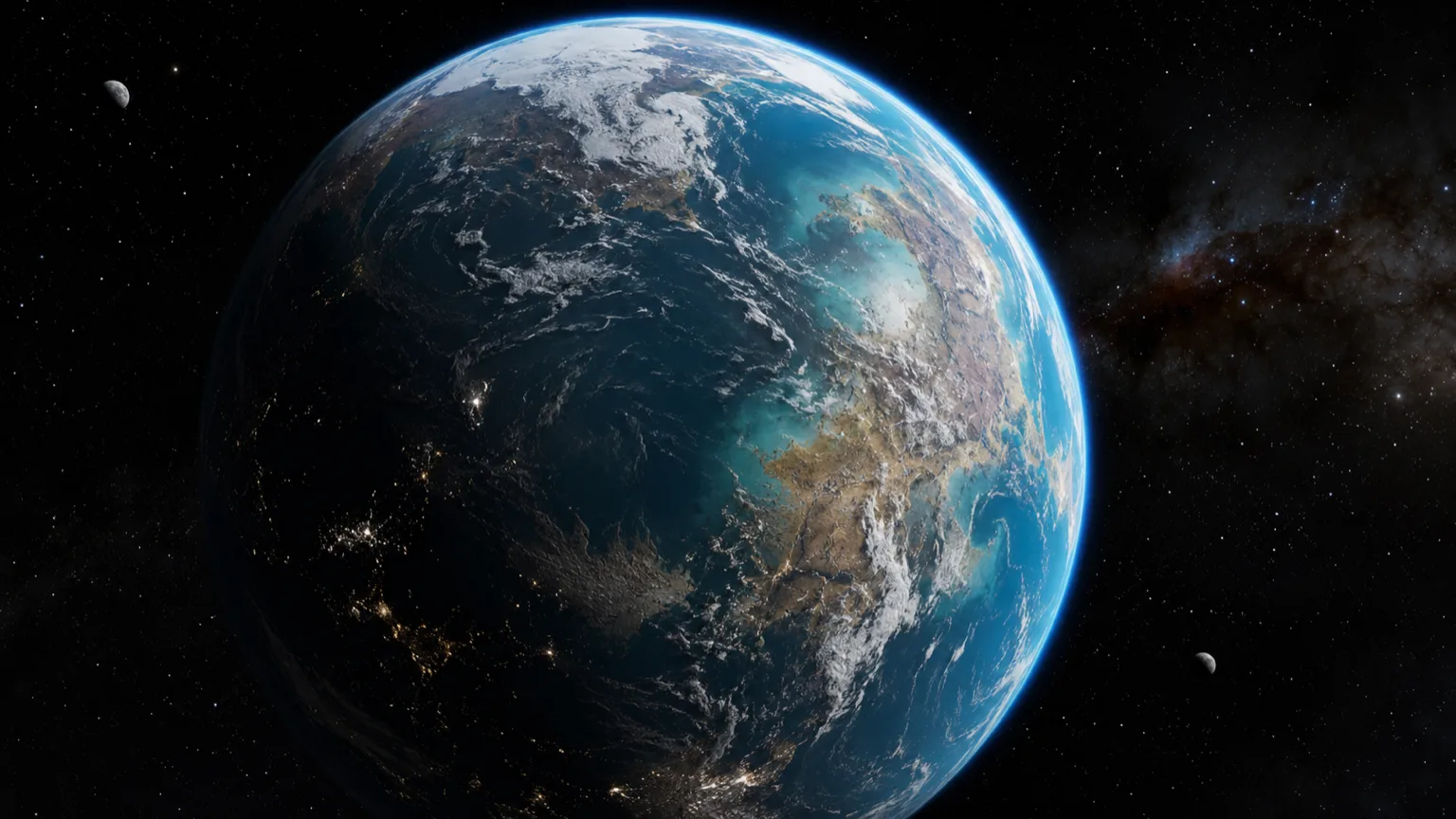
Nerya is a world of rock and water slightly larger than Earth: 15,800 kilometres across, a gravity of 1.12 g, a day of 27 hours 40 and a year of 418 days. The average temperature is 17 °C, the air is nitrogen and oxygen, and a human could breathe it without apparatus — which, in the Codex, is never a small detail.
The archivists of Oravaya Prime hate writing the name down. Nerya has nothing to do with the Norya Belt: it circles the star of Vandoria, at the far end of the charts, in the same system as Sayop. One letter separates them, and centuries of misfiled reports.
The turquoise oceans
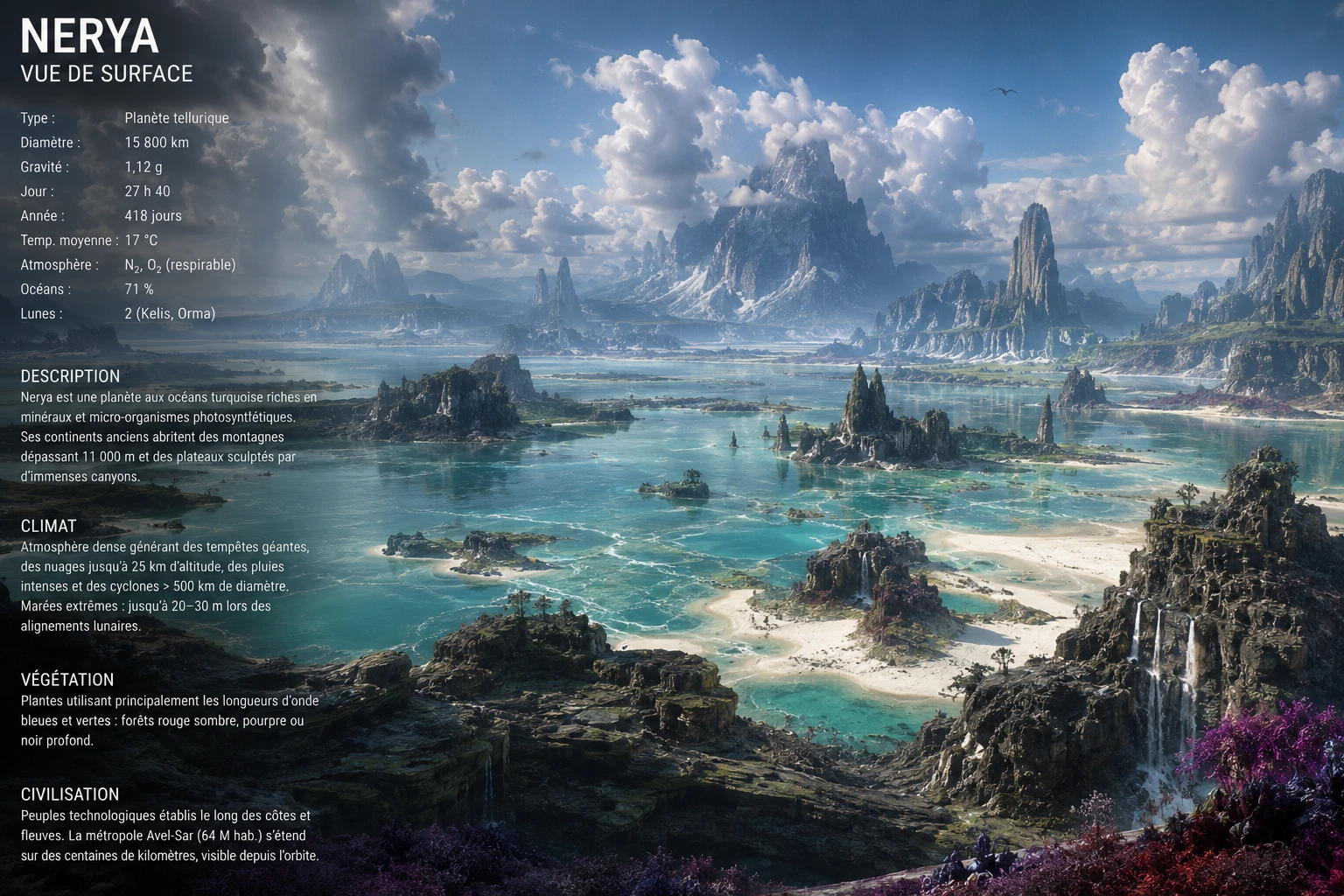 Water covers 88% of the planet, and it is no ordinary water. Nerya’s oceans are loaded with dissolved minerals and with micro-organisms that live on light: they take on an almost luminous blue-turquoise, visible from space like a polished stone. In the deeps those same organisms glow — divers descend through sheets of cold light that drift on their own.
Avel-Sar, the city lying down
 The small lights on the night side are not natural. Nerya carries a technological civilisation, settled along the coasts and the great rivers. The largest of its agglomerations, Avel-Sar, holds roughly 64 million inhabitants and shines brightly enough to be spotted from several hundred thousand kilometres out.
But the Neryans almost never build upward. Where Sayop stacks its megacities into the clouds, Avel-Sar follows the relief and spreads across hundreds of kilometres, wrapping around deltas and valleys. Seen from above it is not a tower: it is a root.
The purple forests
 Nerya’s vegetation is not green. Its plants absorb mostly the blue and green of their star and reflect the rest: the forests are dark red, purple, sometimes almost black. From the ground the picture is complete — pale blue sky, turquoise sea, grey mountains grazing 8,000 metres — the ceiling of what 1.12 g will let stand, and violet-black forests climbing their feet.
The fauna follows the same logic of the strange: large amphibious animals that cross between the two worlds without giving it a thought, flying creatures that exploit an atmosphere denser than ours, and predators able to feel the electric fields of their prey before they ever see them.
A sky with no measure
 Nerya’s atmosphere is thicker than Earth’s, and everything in it takes on outsized proportions: clouds rising past 25 kilometres, tropical rains that can drown a valley in a night, cyclones more than 500 kilometres across, and polar aurorae seen as far as the temperate regions.
And then there are the two moons. Kelis and Orma pull on the same oceans, and when they align the sea rises by twenty to thirty metres on some coasts. The Neryans do not fight those tides: they build knowing the sea will come, and they step aside.